


It looked like a quiet news weekend was shaping up when I closed my laptop at about 11:15 PM Friday.
That changed less than two hours later, when Prime Minister Mark Carney announced he was suspending trade talks with the Trump administration and calling Canada’s negotiating team home.
The time stamp on the breaking news alert from the Globe and Mail: 00:37 Saturday.
To those of us who complain bitterly, repeatedly, and usually with good reason about buried announcements during a long weekend in the middle of summer? We ain’t seen nothin’ yet.
The news cascaded through the country, summer down time be damned. On various errands and dog walks through Ottawa Saturday, Canadian flags had popped up where they might have been months ago, but hadn’t been the day before.
The flag count was anecdote, not quantitative evidence, but it reinforced what we’ve seen in recent polling.
No more concessions.
Don’t cave to the bully—don’t you dare.
#ElbowsBackUp.
Carney clearly read the room, where Trump’s team did not. According to news reports, when the U.S. trade team introduced a bunch of unacceptable fine print at a late stage in the negotiations, Canada walked away, cementing the position that no deal was better than a bad deal.
The story of how it happened began to leak out through the day Saturday, featuring a longtime Trump crony trying to wrest away Canada’s ability to set its own trade and economic strategy as a sovereign nation. In other words, a play for a 51st state takeover in all but name.
Instead of going along to get along, Carney walked—and let Trump push ahead with $28 billion in tariffs that will hurt his own country’s economy at least as badly as ours, with U.S. midterm elections just 10 weeks away. Our dollar for dollar retaliatory tariffs on U.S. products like steel, dairy, appliances, and electronics are yet to be announced; Carney said they’ll take effect Sept. 8, eight weeks before midterms and just six days before his own Canada Investment Summit in Toronto.
There’s so much that could still go wrong here, and it’ll be intensely frustrating for climate hawks to see Carney show a level of resolve on trade that has been absent in his government’s response to a wildfire summer and its embrace of new fossil fuel megaprojects.
But as long as keeping the country whole, united, and sovereign is still a precondition for everything else we need to do, the bombshell news Saturday morning was still reason to smile. And if you tilt your head 30° and shade your eyes just a bit, you can see a path where protecting Canada itself is still a first step toward the climate and energy transition so many of us expected when Carney took office last year.
Sovereignty Is Still Job One
For some time now, I’ve been carrying around the idea that, at least in his own mind, Mark Carney came to office with the shortest job description on record.
You have one job, one job: Protect Canada as an independent nation. Whatever it takes.
That’s it. That’s all. Except that I like to say the job description comes with a footnote:
Job #2: If in doubt, refer to Job #1. If you’re still in doubt, refer to it again. After that, quit referring and get down to work, because time is short and the stakes are high.
So you can assume the PM knew exactly what he was doing when he shut down negotiations late Friday evening. The statement is well worth reading in full, but here’s where he gets to the heart of the matter:
We have recognised [official documents use British spelling now] from the beginning that America has changed, and that we will not return to our old relationship. Our government understood, before many, that America is altering all its trade relationships. Putting tariffs on its closest allies and charging for access to its vast market….
[Canada’s negotiators] worked hard, in good faith, to defend the interests of Canadians throughout these negotiations up until the very last minute. However, last-minute changes in the U.S. proposed terms were unfair, uneconomic, and called into question the reliability of any deal.
At midnight tonight, the U.S. intends to impose a 50% tariff on roughly $28 billion of Canadian goods. Canada will match those tariffs dollar for dollar to protect our workers and businesses. [emphasis in the original]
In the coming days, the government will introduce additional measures to support Canadian workers and businesses, building on the nearly $25 billion in support provided over the past 18 months.
The statement includes a laundry list of the strengths Canada brings to the continuing tariff fight: job creation at four times the U.S. rate, non-U.S. exports “on track to double over the next decade”, and the second-fastest economic growth among G7 countries. It also spotlights foreign direct investment at a two-decade high, and Canada’s ranking “as the most attractive country in the world for infrastructure investment”—messaging that points directly to the Canada Investment Summit Sept. 14-15, with 100 to 150 of the world’s biggest investors on the guest list.
A 51st State in All But Name
The details emerging from the 11th-hour talks show why Canada’s only option was to walk away. On Saturday morning, Carney “offered several examples of U.S. demands that Canada could not accept, including the fine print related to potential agreements on steel, aluminum, and autos, and language that he said would have restricted Canada’s trade negotiations with other countries,” the Globe and Mail reports.
Allowing the U.S. to control or constrain those independent trade deals would have amounted to annexation in all but name.
“The recent developments in this negotiation, though I hesitate to even call it that… revealed the true nature of what the Americans are seeking,” said British Columbia Premier David Eby. “The suggestion that Canada would not trade with other countries or reduce our trade with other countries because the Americans tell us to would reduce us to the economic equivalent of the 51st state.”
Ontario Premier Doug Ford opined Trump “is a type of person that would steal your lunch money the first day. He’d steal the toque off your head the second day, and the third day he’d steal your running shoes. He’s not to be trusted whatsoever.”
American negotiators were even going after protections for French culture, including the requirement for bilingual labels on products sold in Canada, CBC says. Quebec Premier Christine Fréchette said Ottawa was right to reject provisions that crossed some of the province’s “red lines” and should never have been part of a trade negotiation.
“Our culture, our language, is central to our identity,” she declared.
Now, suggestions are popping up on Threads that future news interviews with widely-reviled U.S. Ambassador Pete Hoekstra should be conducted in French—then Cree, Inuktitut, and Athabaskan (Dene). If and when that happens, we’ll buy the popcorn. (If you haven’t yet signed the petition to get Hoekstra kicked out of Canada, you know what to do.)
When the trade negotiations came down to the wire, “there were some things we wouldn’t do. We were not prepared to compromise Canada’s sovereignty or to undermine key industries,” Carney told. “In short, they asked too much, and they offered too little.”
‘You’re At War When You’re Attacked’
In what CBC called a departure from “his usual diplomatic language”, Carney said it was also becoming clear that the U.S. trade delegation wasn’t speaking with one voice—that sometimes, the United States signs trade deals “written in pencil”.
A reporter asked: “Why does it feel like, today, Mark Carney is going to war, trade war?” Carney responded:
You are at war when you get attacked. We got attacked. That’s fine. We’ve got the reserves. We’ve got resilience. We’ve got the plan. We’ve got the focus. We’ll respond—we are going to focus on what we can control. We are going to build.
The one, predictable breach in the armour came from Alberta Premier Danielle Smith, who launched into a rousing game of both-sidesism from a province with just $1.5 billion of its $188-billion trade volume with the U.S. at risk, according to CBC. While the Mar-a-Lago-friendly Smith allowed as how the U.S. demands were “untenable” and “too painful” for Canada to accept, she said: “I hope that they can get back to the table to negotiate something that’s more fair. I’m really hopeful that some constructive conversations begin because, boy, the tariff war is painful.”
Smith must surely understand how badly that position misses the point, and by missing the point, seeks to sell the country out.
“This was never a trade negotiation as we normally understand that concept. It was always a test,” writes Social Capital Partners CEO Matthew Mendelsohn. “It has been clear for a long time that Canada was being presented with a big strategic choice that would define our country for the foreseeable future: accept subordination and abandon our sovereignty, or accept real disruption and short-term pain as we chart a new uncertain course.”
And in the end:
Canadians have clearly understood what MAGA is and the threat that Trump represents to successful democratic societies that embrace pluralism, the rule of law, human rights, and open, competitive markets. Canadians understand that the American authoritarian right is a threat to our children and grandchildren.
I honestly didn’t know which way the Prime Minister would go. But I am so relieved with his choice. We cannot overstate how significant the choice is for our future. I’m so proud of my fellow citizens for their courage.
Hitting the Dictator Where It Hurts
Climate hawks know there’s another, wider fight that everyone, everywhere needs to win. And that some of the biggest, most significant steps Canada could take on climate change and a fossil fuel phasedown are also power moves that would help bring down the Mad Dictator and his gangster regime, once and for all.
So it’s beyond confusing, disappointing, and mind-boggling to see Carney and his brain trust evidently put a bitumen pipeline (a good deal for taxpayers, his energy minister Tim Hodgson insists), a batch of new liquefied natural gas (LNG) terminals, and a brutal campaign of environmental deregulation at the centre of that strategy.
The line of thought about Carney’s very short job description produced an important and provocative question from one of my oldest friends, someone who’s been hammering away at this work since the 1970s:
So you’re saying that keeping Canada whole is more important than fighting climate change?
Well, no. Just that we’re in a moment when we have to be able to do more than one big, urgent thing at once—and to do that, we need the tools, systems, and channels we take for granted every day. If anyone thinks we’d be able to comfortably and effectively work on climate change and the energy transition if Canada became a 51st state—if you think we’d feel safe having this kind of conversation out in the open—you haven’t been reading in on the terror state Trump has created on U.S. soil.
But the need to do more than one thing at once cuts both ways. And it turns out that some of the steps Canada can take to secure its climate and energy future are also tailor-made to assert our sovereignty against the Trump menace—and show American voters that the MAGA monstrosity is even worse for their pocketbooks than they thought.
“This trade fights is an opening—a chance for a reset,” writes author, analyst, and climate campaigner Seth Klein in his Emergency Measures newsletter (to which you really ought to subscribe, if you haven’t already). “Canada needs to impose an export tax on oil and gas to the U.S. and stop rewarding the bully’s fossil fuel friends”—including, we might add, the fossil fuel friends who are majority owners of Canada’s oil sands.
“As our country burns and broils from climate-induced extreme weather, if Prime Minister Carney and Premier Eby were looking for an opportune moment to rethink their support for new fossil fuel projects backed by some of Trump’s closest allies—not to mention a great chance to reset their relationships with the environmental movement and climate-anxious Canadians—look no further,” Klein writes.
One reason Alberta Premier Smith can be so casual about the sovereignty fight is that the U.S. has always exempted Canadian oil and gas from tariffs. Klein says that’s a tell, showing that U.S. fossil companies’ lavish support for Trump’s 2024 election campaign has become his vulnerability now that he’s back in the White House.
“A large share of the oil and gas industry in Canada is U.S.-owned, and its product is largely shipped to parent companies in the U.S. where it is refined and sold,” Klein writes. “These folks don’t relish having to pay the extra costs that would result from tariffs.”
Which is precisely why Canada should impose a 15% export tax on U.S.-bound oil and gas, he says.
“Smith and the oil and gas companies themselves will blow a gasket,” Klein fearlessly predicts. (We’ll keep buying the popcorn until the popcorn runs out.)
But a strong case can be made that layering an export tax on oil and gas is a fair approach within the overall Canadian response. First, an export tax on oil and gas would even the pain, ensuring all industries are shouldering a similar burden of our collective fight-back. Second, unlike Trump’s tariffs (which the U.S. will collect), an export tax can raise billions in revenues for Canada—money that can then be redeployed to support workers and industries harmed by the U.S. tariffs.
Canada’s electricity exports could be another pressure point, and on Saturday, B.C. Premier Eby wouldn’t rule out restricting them. “Every possible tool, every weapon that can be deployed by the federal government in this economic war that is being waged on Canada, is on the table,” he told media.
Klein goes into long, essential detail on public support for an export tax, the fossil industry’s continuing demands for a “trade diversification” strategy centred on oil and gas pipelines, U.S. ownership of the Canadian industry (including some of the big-ticket investment houses that will be dropping in for Carney’s investment summit next month), and the opportunity to “redouble on renewables, and to wean ourselves from the fossil fuel industry once and for all.”
The End of the World vs. the End of the Week
The headline for this post isn’t quite right, and neither is the subhead for this section. The original phrasing, conveyed second hand by a friend and colleague, was: “What is more important, the end of the world or the end of the month?”
It took Trump, his commerce secretary and longtime sidekick Howard Lutnick, and the rest of the band of MAGA thieves to compress the timeline to a week. But the story behind the phrase tells you a lot about what’s missing in the planning for the Canada Investment Summit, and so much of what’s been wrong in the way the climate community presents itself on trade and economic issues.
One of our team wrote this a couple of weeks ago on an in-house discussion channel:
I’m having an online conversation today with my cousin who lives in France (they are not seeing the direct impact of the wildfires or smoke, just the heat and the general anxiety). Just sharing the way he framed the existential discussions he hears happening all around him, because we don’t always hear it this way: he says it’s a question of “what is more important: the end of the world or the end of the month.” Maybe that’s a more common framing than we realize, but it’s pretty poignant.
It’s been obvious for years that people won’t often have the time or space to confront climate change head-on when they’re living through its worst impacts. Nor even when they’re up against a continuing, grinding cost of living crisis that is fuelled in part by the climate emergency and continues to dominate every survey of public priorities. With all the big-picture economic statistics that Carney can quote, it isn’t at all clear that his big investment summit next month will bring home the nation-building projects that work for the rest of us.
Those would be the projects that build the nation—build the nations, actually, if we really mean it about reconciliation with Indigenous peoples—rather than undercutting our biggest strengths and driving us farther apart.
It isn’t as though there’s been a shortage of guidance. During the last election, then again after the votes were counted, more than 250 municipal leaders behind the #ElbowsUp for Climate campaign issued a list of “nation-building, not nation-burning” projects that included:
• A national clean power grid;
• Building two million energy-efficient, non-market homes;
• Energy retrofits for low-income homes and multi-unit buildings;
• A national high-speed rail and intercity bus system;
• Implementation and funding for a “national resilience, response, and recovery strategy.”
Now, Adamant is out with an overlapping list of priorities: Tapping into Canada’s geothermal energy “bedrock”, wiring Canada together through a national electricity grid, tripling clean power production, building two million smart homes, and recognizing energy retrofits as “the obvious energy fix”. (Watch this space—we plan to profile each of Adamant’s five briefings in the lead-up to the Canada Investment Summit.)
All of these projects meet Carney’s call to “Build Canada Strong”, and they get it done by building from the ground up. They all deserve a place at the centre of Canada’s response to the Trump trade war. And this isn’t an area where the government has been entirely silent: Ottawa announced a limited return to energy retrofits in late June, and the National Electricity Strategy has generated praise and optimism while triggering the biggest clean energy investment in North America.
The Missing Piece
But there’s still an essential missing piece that Carney highlighted in his Friday evening remarks, with his reference to small and medium-sized businesses as “the lifeblood of our economy.” If the PM means it—and if he’s the numbers guy he prides himself on being, he should—he’ll know there’s a gap in his strategy. A government that spends an inordinate amount of time listening to fossil fuel lobbyists isn’t hearing from farmers and other small landholders who aren’t receiving their lease payments from oil and gas operators. An investor summit with a minimum deal value of $200 million, so we’ve heard, won’t take in most of the nation-building projects we need today, despite their powerful potential to scale up for tomorrow.
If the price of bringing the world’s biggest investors to the table is to only show them projects at the scale they’re accustomed to—in an #ElbowsUp moment, depending on the nature and impact of the projects themselves, Carney should do what he has to do. But only if he recognizes that the list he presents to the elite investors will define the limit as well as the opportunity in what the summit can achieve.
The fossil fuel megaprojects that have received such avid support from Carney and Hodgson are tailor-made to divide communities, corrode the natural systems we all depend on, and saddle communities with stranded assets as most of the rest of the world moves on to clean energy, all while closing off more practical options that serve economic and climate goals together. The recent wave of AI data centres, often imposed on rural communities with no advance notice and against their will, is bringing people together across political lines—but not in the way any government would likely want.
The priorities on the #ElbowsUp and Adamant lists add up to nation-building megaprojects, too. But only if you aggregate dozens, hundreds, or thousands of smaller, local initiatives that save energy, reduce the cost of living, build community resilience, create homegrown jobs that can’t be exported, and cut carbon along the way. That mix of community benefits and community control is what Carney should be looking for, alongside the big-fish investors he’ll be angling for in Toronto next month.
Canadians know that Canadians themselves—our own cohesion, determination, and refusal to bow down when a “sundowning”, factually-challenged Mad Dictator bellows “No more!!!”—are Canada’s best defence. We’ve shown over the last 19 horrendous months that we’re all the biggest strength our negotiators bring to the table. Which means that, whatever else he’s getting right, Carney will soon have to start building from the ground up—and stop bashing away at the environmental protections, social safety net, and climate change response at the core of what keeps Canada strong.

Mitchell Beer traces his background in renewable energy and energy efficiency back to 1977, in climate change to 1997. Now he and the rest of the Energy Mix team scan 1,200 news headlines a week to pull together The Energy Mix and The Energy Mix Weekender.
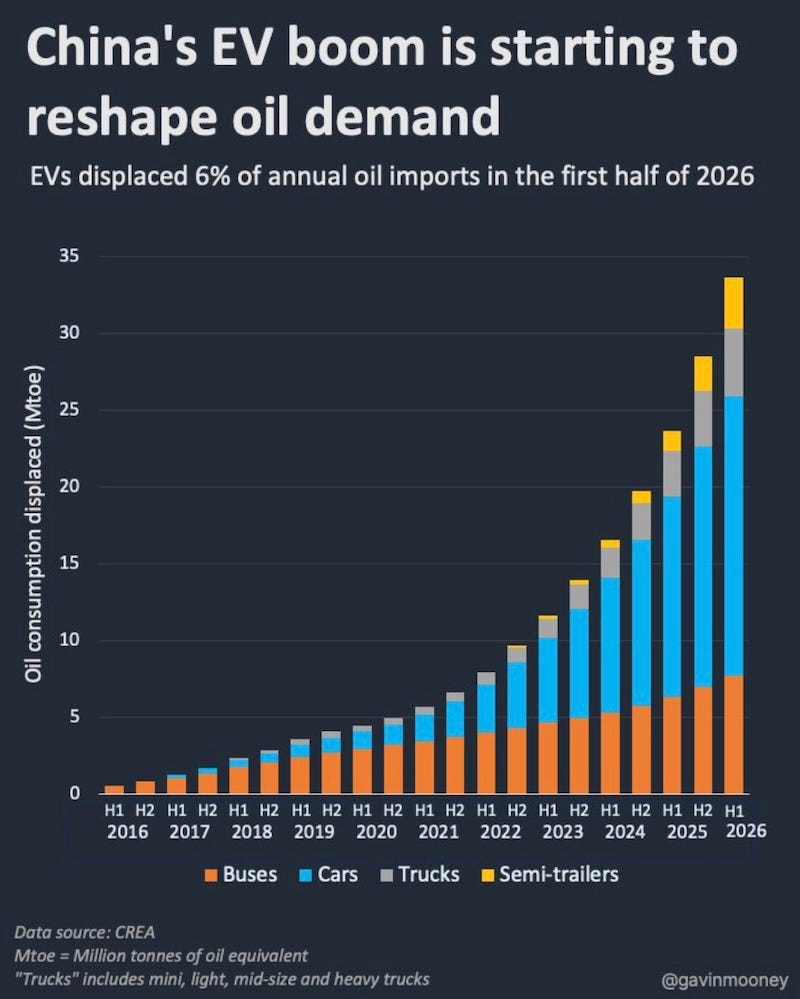
Chart of the Week

Alberta Minister Glubish ‘Peppered with Profanity’ at Second Town Hall on AI Data Centres
What a Supercharged El Niño Could Mean for Canada
Trump’s Tariff Threats Could Prompt Canada to Break Free from Oil
El Niño Weakens, GHGs the ‘Main Culprit’ after Record Year Of Heat, Drought, Wildfires
U.S. Lawmakers Threaten Annexation, Trump Talks Tariffs as Winds Carry Canadian Wildfire Smoke South
Returning Home Different for Everyone After ‘Monster’ Wildfire in B.C.’s Okanagan
Overwhelming Majorities in Canada, U.S. Say No to Local Data Centre Development
Ford Eyes EV Revival With Affordable Fathom e-Truck
Q&A: Climate Action, Community Resilience Begin with Who Owns Our Economy, Jon Shell Says

Canada’s pipeline ambitions hinge on uncertain output expansion (Reuters)
Proposed changes to endangered species law would ‘stab it to death,’ says scientist (Canadian Broadcasting Corporation)
‘People were essentially being tortured’: Federal Court orders CSC to put air conditioning in Edmonton women’s prison (The Hill Times)
Is Canada flunking climate? The picture isn’t great, but there might be a way out (Canadian Broadcasting Corporation)
Art of the seal: Trump-aligned oil group touts ‘sealskin diplomacy’ on Greenland (Financial Times)
Shrinking sea ice makes year-round shipping possible on Hudson Bay: Manitoba premier’s office (Canadian Broadcasting Corporation)
Partners for 150 MW Simcoe BESS awarded contract by Ontario (Sustainable Biz Canada)
Site E dam proposal in northeast B.C. prompts calls for compensation, energy alternatives (Canadian Broadcasting Corporation)
Utility board takeover on Georgia Dems’ minds (Politico)
In Michigan, LG opens one of America’s biggest battery cell factories (Canary Media)
A reality check is needed on Arctic shipping (Financial Times)
There’s a new status quo in Hormuz (Semafor)
Could not have said it better myself.
Carney is up to his ass in alligators right now but he has got to put priorities on everything mentioned in this article.
The world has to stop capitulating to capitalism.
I saw more flags too!